A Network, Not a Funnel: The Lily-Pad Web as Reader Respect
The Web Used to Be Legible
The early web was a series of stepping stones. You landed on a page, saw where the author thought you might go next, and chose. Blogrolls, webrings, visible outbound links—these weren’t leaks in a funnel; they were gifts. The implicit message: I trust you to decide what’s interesting.
Then the funnel arrived—quietly, dressed as optimization.
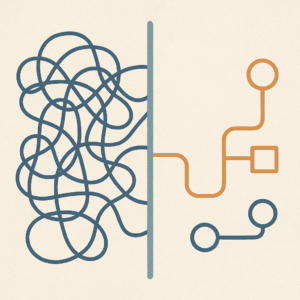
A funnel minimizes choice. A network multiplies intelligible choice. That’s the distinction this essay is built around.
When the Funnel Colonized the Map
By the early 2010s, “conversion rate optimization” had become gospel. A/B testing, heat maps, personalization engines—everything pointed at one metric: did the visitor do the one thing we wanted?
The result: the web became a maze, not a map. Pages stopped offering exits. Links turned suspect—each one a potential “leak.” Every design decision was filtered through a question that had nothing to do with reader agency: does this increase or decrease conversion?
Personalization made it worse. The maze became invisible—different for each visitor, impossible to retrace.
The Lily-Pad Principle
A lily pad gives you three things: footing, context, and options.
You land, you see where you are, and you can see the next pads within reach. You’re never trapped. You’re never unsure whether the ground will hold.
A funnel step gives you one thing: the next step the designer chose for you. Most readers don’t need “nurturing.” They need freedom.
The lily-pad web is a design ethic: every page should orient the reader, not capture them. Navigation should multiply choice, not minimize it.
Network UX: Practical Rules
Build a network instead of a funnel:
- Always show alternative paths. If there’s a related concept, link it—even off-site.
- Label why a link exists. “Illuminates,” “Evidence,” “Counterpoint,” “Offer”—signal the click’s purpose.
- Don’t collapse everything into one CTA. Multiple calls to action aren’t confusion; they’re choice.
- Use counterpoint links. Link to disagreement when it exists. It signals intellectual honesty.
- Publish a navigation manifest. Tell readers how your site is organized and why.
- Disclose distance to offers. “You’re in Explore mode. No pitch for 3 more pages.”
- Make the graph legible. Internal links should reveal semantic structure, not game an algorithm.
AI Will Either Restore the Map—or Hide It Better
Embeddings are coordinates. Every piece of text gets a location in meaning-space; ideas live near similar ideas. That’s the foundation of modern retrieval.
Retrieval-augmented generation (RAG) uses those coordinates to find relevant context, then synthesizes an answer. Done well, it’s a semantic map: you ask a question, the system shows what’s nearby—and why.
Done poorly, it’s a black box. Retrieval is silent. Optimization is invisible. The user gets an answer with no sense of what was considered or excluded.
We choose which version we build.
Why Provenance Matters in Healthcare—Right Now
Healthcare has long run on trust-by-obscurity. The formulary says no. The prior auth requires step therapy. The claim denies. And the clinician—or the patient—is supposed to accept it.
That model is breaking. Not slowly. Now.
The case currently unfolding in a Manhattan courtroom—a former Ivy League student charged with killing a health-insurance CEO—is the most extreme symptom of a legitimacy crisis years in the making. I’m not here to litigate his actions. I’m here to name what made them legible to a surprising number of people.
Recent polling is clarifying. NORC/AP finds roughly eight in ten Americans assign significant responsibility to the shooter—that’s the expected moral consensus. But nearly seven in ten also blame insurer profits and claim denials as contributing factors. Among 18-to-29-year-olds, Emerson reports 41% called the act “somewhat acceptable.” A Generation Lab survey of college students found nearly half sympathize more with the defendant than the victim, with a similar share calling the crime justified.
These aren’t majority positions—but they’re not fringe either. They mark a measurable fracture in the system’s legitimacy. And that fracture isn’t ideological. It’s born of opacity.
People don’t radicalize over a denied claim. They radicalize over a denied claim they can’t trace, can’t understand, and can’t appeal through any process that feels real. When rules are invisible—buried in proprietary algorithms and auto-generated letters—the system stops feeling like a system. It feels like extraction with a logo.
Transparency won’t fix healthcare economics. But it might fix healthcare legitimacy—the baseline belief that decisions follow rules you can see, question, and contest. That’s not small. It’s the difference between a frustrated patient and a radicalized one. Between criticism and contempt. Between reform and the kind of despair that looks for symbols to destroy.
At the same time, AI tools are entering clinical workflows before we’ve agreed on what “transparency” means there. LLMs are summarizing records, drafting appeals, recommending interventions—often without surfacing what they retrieved, what they ignored, or why. Retrieval is silent. Confidence is high. The stakes are someone’s medication access, surgery timing, or pain management.
Meanwhile, regulatory pressure is finally catching up to PBMs and payers. CMS is demanding formulary transparency. State boards are questioning rebate structures. Patients are suing over denied care. The era of “because the system said so” is ending—but only if we build the replacement.
Provenance isn’t a nice-to-have. It’s the difference between a defensible clinical decision and a liability. Between a patient who understands their appeal options and one who gives up. Between an AI tool that augments judgment and one that quietly replaces it. Between a system people merely tolerate and one they trust enough not to burn down.
If you’re building anything that touches clinical decisions right now—intake tools, coverage engines, documentation assistants—you have a choice. Ship fast and hope no one asks where the output came from. Or build the citation layer first and make the map visible from day one.
The organizations that choose legibility now won’t just avoid regulatory blowback. They’ll earn the trust that outlasts any product cycle—and they might help rebuild the legitimacy that keeps the whole system from fracturing further.
A Closing Pledge: Restore the Map
I’m not asking you to trust the model. I’m pushing for provenance and transparency in all my work.
Policy Vault, CNIDs, semantic linking—the goal isn’t to replace judgment. It’s to make judgment possible by making the underlying structure legible.
Nikki Harré frames it as a choice between finite and infinite games: seeking information vs. claiming knowledge; network vs. discrete entities; continuing play vs. winning. Monetization isn’t evil. Opacity is.
The lily-pad web is how we keep playing.