How a Framework Survives the Wrong Room
It does not begin as a thesis.
It begins as deja vu in the wrong room.
You are working inside one domain and something starts to feel familiar. Not the vocabulary. Not the objects. The shape.
A bottleneck. A membrane. A quality filter. A clearance pathway. A gate. A steering surface. A thing that lets some signals through, metabolizes others, and clears the rest before anyone has to say no.
Your body recognizes the architecture before your mind names it.
You have been here before, under different lighting.
That pre-verbal recognition is where some of the most interesting thinking lives. Not inside perfect disciplinary obedience. Not inside systems-theory soup where every field becomes a feedback loop. Somewhere tighter than that.
A structure rooted in one place survives contact with another.
The relationship among parts rhymes strongly enough to matter.
That is emergent portability.
A portable framework is not a vague framework. Vague things travel because they do not say anything sharp enough to break.
Real portability is harsher. The structure travels and still bites.
Not Kuhn
Kuhn’s tension lived inside disciplines: commitment to a paradigm, then rupture from it. Incommensurability was a translation problem.
Emergent portability works in the opposite register.
The tension is rootedness versus transfer.
Can a framework born in one domain cross into another without dissolving? Can it remain specific enough to matter and flexible enough to move? Can it survive foreign stakes, foreign language, foreign institutions?
Here, incommensurability is not the problem. It is the test.
If two fields already speak the same language, there is nothing meaningful to port.
Portability is also carrier-dependent. Patterns do not migrate on their own. They need smugglers. A person. A tool. A metaphor. A prototype. A working diagram. Someone who has lived in one room long enough to feel the architecture in another.
That is why biography matters.
The best porters are often partial apostates. They know a domain from inside, but they are not fully loyal to its borders. The outsider can be dismissed. The loyalist can be trapped. The partial apostate carries the liturgy outward.
Dangerous person.
Useful person.
The narrow band
A portable idea has to live in a narrow band.
Too specific, it stays home.
Too general, it becomes fog.
The frameworks that travel well are memorable and load-bearing. Chesterton’s Fence. Conway’s Law. Gresham’s Law. Goodhart’s Law. Each says one thing with enough force that it survives translation.
Not everything.
One thing.
That matters because portability has a failure mode that feels like insight while it is happening: the horoscope failure.
The framework becomes so agnostic that every situation confirms it. Every organization is a feedback loop. Every policy is an incentive problem. Every bureaucracy is legibility. Every market is capture.
Maybe. Maybe not.
If a framework can explain anything, it predicts nothing. If it cannot be wrong, it cannot be used.
This is where portability needs a tether.
The agnosticism is licensed by the anchor.
Without a stable address, without a receipt, without a local outcome, portability becomes vibe. A clean metaphor floating above systems that did not ask to be flattened.
With a tether, portability becomes a disciplined search procedure.
What is the local primitive? What is the binding? What receipt would tell us whether the imported structure holds? What would falsify the transfer?
The pattern flies outward.
The evidence pulls it back.
That is the tension. Centrifugal and centripetal. Both, or the thing becomes either provincial or useless.
Pattern versus mechanism
Two things get called portability.
Only one is strong.
The first is mechanism portability. The same causal structure recurs. Principal-agent problems travel because delegated authority, asymmetric information, and misaligned incentives recur.
The second is pattern portability. The shape resembles another shape, but the underlying mechanism may differ.
Both can help. They fail differently.
Mechanism portability supports prediction.
Pattern portability supports orientation.
The mistake is pretending the second is the first.
A bottleneck in a liver enzyme pathway and a bottleneck in an enterprise workflow may rhyme. That does not mean they are causally identical. The rhyme may still help you ask better questions: Where does saturation occur? What compensatory pathways exist? What clears the signal? What accumulates when clearance fails?
But if you start saying the organization is literally a liver, stop.
You are costume-designing.
ADME as live specimen
ADME is not poetry in pharmacology.
It is how a substance enters a system, moves through it, gets transformed, and gets cleared.
Absorption. Distribution. Metabolism. Elimination.
Before porting it, honor it.
Drug metabolism is architecturally beautiful. Multiple CYP450 isoforms with overlapping substrate affinity. No central controller. No signaling molecule saying detour. When one pathway saturates, another can absorb load without a committee meeting. Pure distributed resilience, running continuously in every human body, and almost nobody writes about it because pharmacology gets treated as plumbing rather than poetry.
That is the part to love first.
Then port.
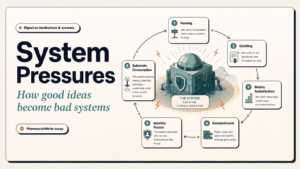
A signal enters an organization. It is absorbed unevenly. It distributes through channels with different permeability. Intermediate actors metabolize it: reinterpret it, activate it, blunt it, distort it, make it safer, make it useless. Then it is eliminated: archived, ignored, neutralized, operationalized, or cleared from attention.
This transfer is not cute because the acronym works.
It is useful because the shape preserves diagnostic force.
Why did the initiative fail? Maybe the signal never crossed the membrane. Maybe it crossed but did not distribute. Maybe it distributed but was metabolized into language leadership could tolerate. Maybe it was eliminated before it accumulated effect.
Now you have questions.
Not certainty.
Questions.
That is honest portability.
CNID as portability caught in the act
Canonical Node ID is emergent portability with a hard edge.
Prior authorization, care management, fraud, risk adjustment, pharmacy operations, appeals. Different domains. Different nouns. Different stakes.
But the deeper architecture keeps recurring:
stable primitive identity, local binding, evidence, governance state, receipt, outcome association.
A coverage criterion is not a care-plan intervention. A care-plan intervention is not a denial reason. A denial reason is not a suspect condition.
Respect that.
Still, each can become an addressable primitive. Each can have local aliases. Each can be proposed by a model and committed by a governed process. Each can generate receipts. Each can attach to outcomes.
That is not analogy alone.
It is architecture.
The receiving domain keeps its specificity. The portable frame asks it to expose its primitives.
This is the difference between transfer and flattening.
Flattening says: everything is the same.
Transfer says: the same kind of structural question may be worth asking here.
The brake
Portability needs Chesterton’s Fence.
Before importing a pattern, ask what would have to be true for the receiving domain to have developed without it.
Sometimes the answer is: nobody saw it yet.
Often the answer is: they tried. Here is the graveyard.
That question does not kill portability. It dignifies it.
It prevents the porter from treating every domain as raw material for their favorite analogy.
The failure modes deserve names.
Metaphor over mechanism. You mistake resemblance for causal equivalence.
False universality. A real local insight becomes a master key.
Prestige arbitrage. You borrow language from a high-status field to make a claim sound rigorous before proving equivalence.
Border blindness. You assume the pattern should transfer because you can see it, while ignoring why the receiving domain resisted it.
Tourism. You visit a domain long enough to extract a metaphor, not long enough to be corrected by it.
The correction is simple.
Love the specimen first.
Then move.
The moment before naming
The best part still happens before the diagram.
You are stuck. The local language has stopped helping. Then another domain enters the room quietly.
The problem loosens before it resolves.
Not an argument yet. Not a framework. An orientation shift.
A sudden sense that this problem has an older skeleton than its current vocabulary suggests.
The body knows first.
The naming comes later.
That is why these moments happen in slack: walks, showers, the dead minutes after concentration breaks. Execution mode grips too tightly. Portability needs enough looseness for a foreign structure to surface.
The insight arrives as felt isomorphism.
Then comes the work.
Test whether the feeling survives articulation. Test whether mechanism matches or merely rhymes. Test whether the receiving domain can bear the import without distortion. Test whether the claim can be tethered to an address, a receipt, an outcome.
Do not solve the interrelatedness too early.
Do not flatten the fields.
Do not worship the border.
Do not ignore it either.
Follow the curiosity.
Let the pattern appear.
Then make it survive the crossing.