Every ambitious AI company eventually discovers the same temptation: if knowledge is valuable, gather all of it.
Capture every customer call. Summarize every implementation. Record every product decision. Index every deployment pattern, every win, every mistake, every workaround. Feed it into a context graph. Let agents retrieve it. Let the organization move faster because the organization no longer has to remember through individual people.
The hive mind is an answer to real waste. Most companies leak knowledge constantly. A lesson learned in one account never reaches the next. A sales objection gets solved three times by three different people. A deployment pattern lives in the head of one engineer until that engineer leaves. A clinical nuance gets discovered in a demo, then disappears into Slack.
But there is a danger inside the same move.
When everything enters the shared mind, knowledge can start to lose its edges. The source fades. The dissent gets softened. The uncertainty gets rounded off. The original thinker disappears into the graph. A hard-won judgment becomes a reusable snippet. A live disagreement becomes a summarized best practice. The company gets faster, but it may become less able to tell the difference between what was known, what was inferred, what was guessed, what was contested, and what was merely convenient.
That is the challenge I want to name: the difference between hive mind and federated expertise.
A hive mind asks: what does the organization know?
Federated expertise asks: who knows this, from what domain, under what authority, with what evidence, at what point in time, and against what dissent?
The distinction matters because the future of clinical AI will not be won by companies that merely retrieve the most context. It will be won by companies that know how to govern judgment.
The Problem with Flattened Knowledge
Consider a payer knowledge graph that has absorbed five years of GLP-1 coverage decisions.
The graph knows that many previous policies required a trial of metformin, lifestyle intervention, or another preferred therapy before GLP-1 coverage. It has seen denial rationales, appeal overturns, medical director comments, competitor policies, state Medicaid criteria, internal formulary notes, and clinician complaints. When asked to generate a new GLP-1 coverage policy, it produces a persuasive synthesis.
But what exactly did it synthesize?
Some of that knowledge may have been anchored to FDA label language. Some may have come from clinical guidelines. Some may have reflected public payer convention. Some may have been a commercial formulary strategy. Some may have been the preference of one medical director at one point in time. Some may have been copied from a competitor policy whose original rationale was never clear.
If the graph cannot distinguish those roots, the answer may look authoritative while being structurally confused.
That is the danger of flattened knowledge. FDA label language, clinical evidence, payer convention, commercial strategy, implementation constraint, and sales-demo assumption all live near each other semantically. But they do not carry the same authority. A system that blends them into one smooth answer may become semantically rich while becoming epistemically sloppy.
The problem is not retrieval. The problem is governance.
Context is not knowledge. Knowledge is not judgment. And judgment that cannot show its lineage should not be allowed to trigger clinical or operational action.
Federated Expertise as an Alternative
Federated expertise starts with a different assumption: not all knowledge should collapse into one shared brain.
Some knowledge belongs to clinical evidence. Some belongs to implementation history. Some belongs to customer-specific workflow. Some belongs to regulatory interpretation. Some belongs to commercial strategy. Some belongs to product architecture. Some belongs to lived operational judgment.
These domains should be connected, but not blended beyond recognition.
The better model is not one undifferentiated hive. It is a network of governed knowledge domains, each with its own provenance, review path, lifecycle, and authority boundary. Expertise remains distributed, but the objects it produces become interoperable.
In other words:
Federated expertise means shared grammar without collapsed authority.
A clinical policy expert can produce a criteria unit. A product engineer can produce an implementation pattern. A sales leader can produce a market signal. A compliance reviewer can produce a governance constraint. An agent can propose an extraction. But each output should carry its source, its confidence, its review state, and its downstream use.
The company still compounds. But it compounds with lineage.
That is the difference.
A hive mind says: “We know this.”
A federated expertise system says: “This was proposed by this source, reviewed by this person, promoted under this rule, used in this workflow, and later revised because this condition changed.”
That is not slower. That is stronger.
What Older Knowledge Traditions Already Knew
Science understood this problem long before generative AI.
Science does not progress because every idea is immediately merged into consensus. It progresses because claims are exposed, criticized, replicated, revised, and sometimes overturned. The scientific record preserves disagreement because disagreement is part of the machinery of truth. A theory is not simply “knowledge.” It is a claim with a history, a scope, a method, a set of rivals, and a record of surviving or failing tests.
Librarianship understood it too. A library is not merely a pile of books. It is a system of metadata, provenance, cataloging, retrieval, and preservation. It respects the difference between a primary source, a commentary, an index, an edition, a translation, and a later interpretation. Organization is not administrative decoration. It is what makes knowledge durable.
Intelligence tradecraft adds another lesson: raw information, source reliability, analytic confidence, dissenting views, and decision relevance must be separated. A serious analyst does not merely ask, “What do we know?” They ask where it came from, how reliable the source is, what assumptions are being made, who disagrees, and what would change the assessment.
These fields converge on a shared truth:
Knowledge becomes more valuable when its lineage is preserved.
AI systems need that lesson urgently.
Preserving Variance
The hive mind naturally pressures variance downward.
If everyone queries the same system, gets the same synthesis, and feeds corrections back into the same memory, the organization may converge quickly. Sometimes that is useful. But sometimes the outlier is the signal.
The dissenting view may be the early warning. The junior person may see the contradiction because they have not yet been trained to ignore it. The minority interpretation may look wrong until the surrounding facts change. A policy concern that seems excessive in one quarter may become obvious after a regulatory shift, a patient safety event, or a failed implementation.
A healthy knowledge layer should not store only the current answer. It should preserve the shape of disagreement over time.
That means the system needs room for rejected alternatives, unresolved questions, confidence levels, original source material, dated predictions, decision rationales, and later updates. Not everything should be promoted into production. But important dissent should remain visible enough that the organization can learn from it.
This is where receipts become powerful.
A receipt is not just proof that something happened. It is a way to bind a judgment to a moment in time.
What did I believe then?
What evidence did I have?
What would have changed my mind?
What later unfolded?
The goal is not to prove that someone was always right. That would be brittle and dishonest. The goal is to build a record of calibration.
A serious thinker earns trust not by never being wrong, but by becoming legible over time.
The Calibration Ledger
Clinical AI needs a calibration ledger.
Not just “what did the model answer?” but “what judgment was made, by whom, from what source, under what uncertainty, and with what later outcome?”
This is different from credentialed authority. It is not “trust me because of my title.” It is closer to a longitudinal record of reasoning.
The ledger says:
Here is the claim.
Here is the evidence.
Here is the uncertainty.
Here is the decision point.
Here is the expected consequence.
Here is the update when reality responded.
Over time, that ledger becomes a form of authority.
Lineage is the difference between “this policy was approved” and “this policy was proposed by the medical policy committee on April 15, anchored to FDA label language and ADA guidelines, modified after pharmacist review, and valid through the next P&T cycle.”
For clinical AI, the important questions are operational.
When should an AI output become workflow-triggering? When is human review mandatory? When should the system pend instead of infer?
These are not philosophical side quests. They determine whether clinical AI becomes an acceleration layer or an accountability failure.
An ethical node is a point where the system could choose speed, but should perhaps choose governance.
A model extracts criteria from a medical policy. Should those criteria become executable?
An agent summarizes a clinical record. Should the summary trigger an approval, a denial, or only a human review?
A coverage policy changes. Should old decisions be replayed under the new rule, or preserved under the rule active at the time?
These are the moments that matter.
The future of clinical AI ethics will not be decided only by grand principles. It will be decided by thousands of small promotion decisions: candidate to reviewed, reviewed to accepted, accepted to deployed, deployed to workflow-triggering.
That is where ethics becomes architecture.
The Clinical AI Ethicist as Provenance Steward
The clinical AI ethicist of the future may not look like a philosopher sitting outside the system, writing principles after the fact.
They may look more like a provenance steward.
Someone who asks whether an output has the authority to act. Someone who distinguishes source types. Someone who knows when a model-generated artifact should remain a draft, when it should be promoted, and when it should be blocked. Someone who cares not only whether the system got the right answer, but whether the answer can be traced, replayed, disputed, and improved.
This role is not anti-automation. It is pro-accountability.
The best clinical AI ethicist will not merely say “keep a human in the loop.” That phrase is too blunt. The better question is: where should human judgment enter the promotion path, and what kind of evidence should be required before an output becomes operational?
That is the real work.
The Human Ledger
There is also a personal dimension.
In a world where every insight can be ingested into a company graph, individual thinkers need a way to remain legible. Not because knowledge should be hoarded, but because authorship matters.
The origin of an idea can tell us something about its domain, its intent, its limits, and its evolution.
If I propose a reference model today, and it becomes part of a company’s operating layer tomorrow, and four years later it has been modified by dozens of people and reused by agents across hundreds of workflows, what remains of the original judgment?
The answer should not be “nothing.”
The answer should be lineage.
A healthy knowledge system should show how an idea moved:
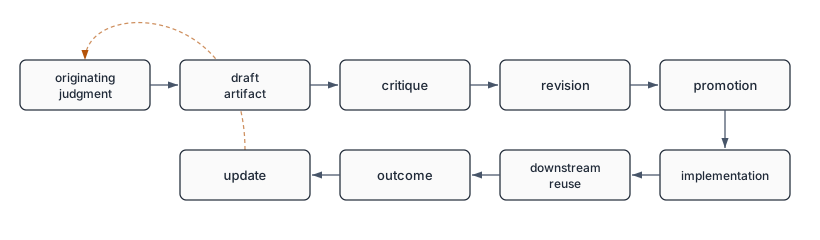
This is not ego preservation. It is epistemic hygiene.
If the company wants to learn, it should know who saw what early, who challenged it, who improved it, who operationalized it, and what happened next.
Institutional memory should not erase authorship. It should make authorship more useful.
Closing
The hive mind is coming because the economic logic is too strong to resist. Companies will capture more context, build more agents, automate more recurring work, and expect every team member to contribute to the shared intelligence layer.
That is not inherently bad.
But if we do not design for provenance, we will create systems that remember everything except why it mattered.
Federated expertise is the alternative. It preserves the benefits of shared intelligence while protecting the authority boundaries that make knowledge trustworthy. It lets companies move fast without flattening dissent. It lets agents propose without pretending they have judged. It lets humans review without forcing all expertise into one generic workflow. It lets artifacts graduate into production with receipts.
The future should not be a choice between isolated experts and a shapeless hive.
The future should be a federated intelligence system where expertise remains legible, disagreement remains useful, and every important judgment carries its lineage forward.
Not consensus for its own sake.
Lineage. Receipts. Calibration. Trust that can be replayed.
That is the arc worth building.