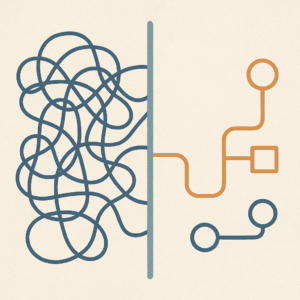
There’s a strange optical illusion we all participate in.
From the outside, expertise looks like comfort.
It looks like someone moving through the world with fewer frictions—fewer hesitations, fewer pauses, fewer “ums.” It looks like they were born fluent. Like they’re simply like that.
But comfort is the final costume, not the origin story.
What we call expertise is usually the residue of private repetition: a long streak of small attempts, each one honest enough to change you, your product, or your workflows. The world sees the polished motion and assumes the polish was the point. It misses the mechanism: someone made exploration their default setting long before it looked impressive.
The Misread: Comfort as Talent
Most people observe the surface:
- A clean opinion delivered without wobble
- A system that “just works”
- A sentence that lands like a gavel
- A strong decision made with surprising speed
And they conclude: talent, innate comfort, a naturally higher altitude.
But the person you’re watching often isn’t comfortable. They’re familiar. They’ve built a relationship with uncertainty. They know its smell. They’ve stood in that room before.
The audience thinks the expert is calm because they’re fearless.
More often, the expert is calm because they’ve been afraid in the same direction a hundred times over.
Confidence is a lagging indicator.
The Hidden Engine: Reps with Discomfort Intact
Practice doesn’t just increase skill. It increases your tolerance for the sensation of not knowing.
Early-stage exploration is humiliating in quiet ways. It isn’t cinematic. It’s not an “aha!” moment. It’s you staring at a thing and realizing you don’t yet have the internal furniture to let it sit down.
Exploration is uncomfortable because it reveals your current ceiling.
And because we’re social creatures, discomfort carries an extra tax: we assume discomfort is evidence of inadequacy. We interpret friction as a verdict. We don’t just feel resistance—we let resistance temporarily define us.
But discomfort is not a verdict.
Discomfort is the sound of growth happening in real time.
When Exploration Becomes Default
At some point, explorers stop treating uncertainty as a detour. They treat it as the path.
They don’t “visit” discomfort. They live near it.
They expect the early clumsiness. They normalize the awkwardness. They see confusion not as an emergency, but as vital information. And because of that, they stop burning energy on self-judgment and redirect it into iteration.
This is why exploration becomes impressive to outsiders: while most people are still negotiating with discomfort, the explorer has accepted it as rent.
The explorer is not necessarily smarter.
They’re just more willing to stay in the room when the room gets weird.
The Glamour of the Finished Product
We reward what is visible:
- the fluent final language
- the clean interface
- the refined stance
- the beautifully argued essay
But the real work happens underground, where there’s no applause.
Underground, you write drafts that don’t cohere. You ship posts that underperform. You build pages that look wrong. You try a tool, abandon it, circle back, and realize you misread the problem. You discover the thing you thought was “the point” was only a proxy for something deeper.
This phase doesn’t produce the kind of evidence the internet celebrates.
It produces internal upgrades.
And those upgrades eventually look like comfort.
Expertise as a Social Misunderstanding
The social environment punishes visible exploration.
When you show your process, you risk looking amateurish. When you admit uncertainty, you risk being misread as unqualified. When you change your mind publicly, you risk being labeled inconsistent.
So people hide the exploration, then suffer from the myth that no one else explores.
This is why the optics of expertise can be discouraging: it makes the growth path seem inaccessible. People believe they’re failing because they feel what everyone feels in private.
But exploration isn’t an aberration.
It’s the job.
The True Flex Is Continuing Anyway
There’s a kind of courage that isn’t dramatic. It doesn’t look like heroism.
It looks like:
- publishing the post even if you’re unsure it will land
- building the page even if the idea feels small
- learning the tool even if you feel behind
- rewriting until you hear your own voice again
- staying in motion while still unready
Over time, that motion compiles.
Not into perfection—into range.
Exploration creates range: the ability to walk into new rooms without requiring the room to accommodate you. And that range becomes what others call “natural.”
The Core Truth
Comfort is what exploration looks like after it has been absorbed.
People romanticize confidence because it looks like certainty. But certainty is brittle. Exploration is resilient.
Exploration is the habit of updating yourself. It’s the repeated decision to move forward in the presence of incomplete information—without turning that incompleteness into a shame story.
That’s why it creates real growth. Not because each individual attempt is brilliant, but because each attempt is honest.
The Quiet Invitation
If you’re in your second or third or fourth year of building—publishing, learning tools, using AI as leverage—the most important thing isn’t to look comfortable.
It’s to keep exploring.
Because the impressive version of you isn’t the one who stopped feeling awkward. It’s the one who refused to let awkwardness be a stop sign.
And when that becomes your default—when exploration becomes how you relate to the world—you don’t just build a blog, empty service or failed go-to-market product.
You build personal infrastructure.
You build the ability to become someone new on purpose.
Discomfort isn’t proof you’re not built for it.
It’s proof you’re still building.